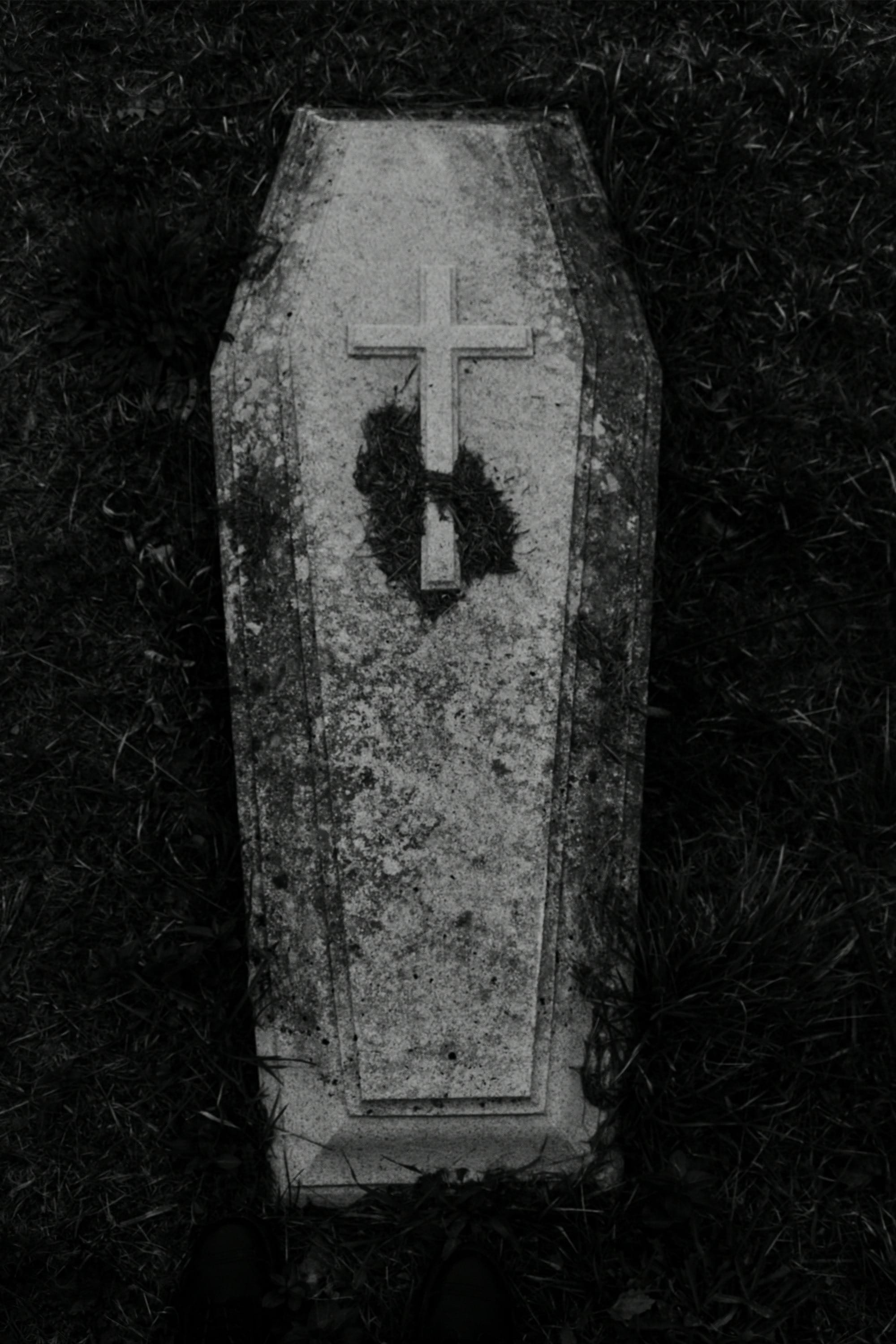
Written By: Spencer Rohloff
What a lovely grave I’d dug! The ground was soft from last night’s rain and came up easy by the spadeful. Springtime fragrance filled my nose and all I smelt was sweetness. I would have enjoyed this more if not for the two boys prattling behind me.
They were rather moody, dressed in black finery. They looked almost like royalty: a prince and his counsel. My ears perked as they spoke of the grave I made. How unsettling it was, they said, that I could find such merriment while doing so. I wanted to say, “But look how nicely I’ve dug it out! Would you not be lucky to rest here?”
I couldn’t find the courage to say so. I stopped my song and finished the grave.
More of the funeral party arrived, dressed equally as noble as the two boys. An old man and his wife: the woman kissed the moody boy’s cheek. She must have been his mother. Another boy trailed behind, the same age as the others. He looked troubled, and he rubbed the edge of his nail against his thumb until it bled. His eyes fixed on the growing pit in the ground, as if it were depthless and growling with hunger.
I hopped from the grave once I’d finished and stepped aside for a cigarette while the casquette lowered in. The attendees said their parting words—the woman scattered flowers over the coffin—and it was done.
The air grew thick and tense as they waited for me to finish the burial. I flicked the last of my cigarette into the dewy grasses and took up my spade. Hardly two scoops fell over the coffin when that flighty boy jumped into my excavation.
“Wait!” he said, clawing at the lid of the coffin with such feral strength as to pry it open. The nails showed like jailcell bars. “Hold off your burying! Let me see her once more! When I’ve held her again in my arms, then, sexton, you may pile dirt over both our heads until it dwarfs the dormant peak of St. Helens! Bury me quick with my love!”
Before I could reason with him, the moody boy stepped from the crowd to say, “Laurence, don’t be foolish. If her love is to be buried with her, then let the earth be laid over our heads, not yours. Come, rise from that grave so that I may cut off your miserable jabbering.” He spat those last words like venom.
Laurence, like a meerkat, stuck his head out from the hole. “Damnable Hammond!” he said, leaping out to grapple the moody boy.
“Take your thumbs from my throat! You must know that I hold in me the small thing of danger while you let hang the large thing of arrogance as if it swings between your legs!”
They tumbled to the ground and writhed like tussling snakes.
“Enough of this!” said the father, separating the boys.
“What has gotten into you?” said the woman to her son.
“Nothing,” he said. “Just that I loved her. And it pains me to see the shallowness of this dull boy’s desire.” Turning to Laurence, he said, “You do not weep for her. You weep only that you may no longer have her. That you cannot pose her like a doll in your house, make her an accessory to your life. Vain and stupid, you are! I crave to slit you open to see what blackness slugs through your veins,” he said. “If I have yet proved to you my love, I will prove you this: my hate.”
Hammond rushed at his foe, thwarted by the third boy, his council. A brief struggle: Hammond pulled free and stormed off.
“Horace,” said the old man, “attend to him. Snuff out that flame, his indignation.”
Horace followed after the moody boy.
To Laurence, the old man said, “Pray patience wins both your hearts. Worry not about his wrath, as surely it will pass. Now, shall we be done with this ceremony? Gravedigger,” he addressed me now, “let the poor girl rest.”
I scooped up more dirt, but hesitated to toss it in. Deep below me: the casket, pried open. A broad sliver of shadow like a smile in a dark room. To have stirred up such commotion, she must have been beautiful. I imagined how she lay there in her casket. Her eyes closed. Thick lashes clasped together like the closed leaves of a venus trap. Her lips sealed gently, letting out no draft of life. Soft against my own and pink and soft—her lips. Her neck—smooth skin, silky smooth and pale and leading my eyes down: the corset that bound her. Her body beneath mine, supple, shapely, waiting. And I— I—!
“Gravedigger,” said the old man, fixing my attention.
The handle of my shovel was hard in my hand. I piled on the dirt.
**
I could not focus. She clung to my every thought. I spent the rest of the day trying to busy myself with chores. I cleaned the headstones, trimmed the hedges, pulled the weeds out by their roots. Still, I could only think of her. I caught myself idling. Playing in my mind were visions of my fingers uprooting the laces of her dress. And when I refocused, I found clutched in my hand a bundle of dandelions.
The day closed. Grey sunset, the clouds were laden with storm. At home, I could not rest. My tea before me on the table. I watched steam rise from it with the lithe oscillations of a dancer, and I thought of her. I poured it in the sink and went to bed.
In the dark I lay with my eyes sealed. I pushed my cheek against my pillow until I could hardly breathe. I tried to think only of sleeping but could think only of sleeping with her. My hands pet my sheets, believing them as soft as her nightgown or her bare skin.
Fantasies appeared in my mind of her grave unearthed, her casket spread open by my hand. She, laid there like a doll in her bed, waited breathless and quiet, vulnerable as a fawn. I began to writhe against my bed. With every twitch of my eyes her form shifted. Transient was her beauty. long hair, soft skin, gentle, curving body. I stared at her lips. How they enthralled me! I leaned over her casket, breathed in her perfume. Lilacs, wildflower honey, wet earth, and decay. I met her lips with my lips. Soft against my own like down. She did not kiss me back.
I felt suddenly foolish and shameful, like a schoolboy with his love unrequited. When I turned to leave, she placed her hand atop my own. Frigid as a winter wind rapping on my knuckles, she held me there. She’d sat up. Bounties of hair descended to her waist. She placed her other hand on my cheek and kissed me more, and more, and each kiss was sweeter than the last.
Like gentle snow, she fell to lie again over her soft bedding. Her lips on my lips, her arms wrapped around me, she drew me in to lay with her. My heart thundered. I shut quick my eyes and kissed her deeply. I laid my body against hers so that we locked together. Desperately, I pulled at the lace of her corset. The effort made me pant. Sweat broke across my brow. Finally undone, they came free like roots from soil. Distracted by my triumph, I failed to notice she reached for the lid of the casket. I kissed her more: her cheek, her neck, her collar. She slammed the casket shut and buried us together.
**
The blinds flung open, exhuming me from sleep. My sheets were twisted beneath me and damp. The curtains billowed on a torrent of air. Gentle clacking of the blinds against the wall, wind howling, and my tired breathing. Just a dream. A dream.
I climbed out of bed to re-secure the blinds and saw her standing there at the edge of the neighboring woods. She was luminous as a moonbeam. I could not see her face for the tresses of her hair concealing.
The wind brushed against my flesh, and in that instant I knew she was more than a specter to haunt me. I could capture her, turn her around like a penny in my hands.
She slipt behind a tree and vanished. Like the hound that watched the hare flee, I gave chase. The blinds I left there clattering.
I tore barefooted through the woods. The understory was a tangled mess of roots, difficult to navigate in the dark. My desire to find her dulled the pain of my stumbling. Through the shadows, I could see the glow of her white dress. It swept just out of sight, weaving through the trees like a needle through a loom.
The woods broke and revealed to me a lake. Lily pads tiled the surface. Pallid moonlight reflected off the lake in a thin mist. My labored breathing trampled over the gentle singing of waves, of crickets and toads. Each no more than a whisper.
Before me stood my muse. The lake with its hands encircling her hips. How I wanted to hold her like that. The skirts of her dress floated with the lilies.
I still could not see her face. She looked away from me, towards the lake where lunar globe and stars abstracted on the water. I could see only the handsome slope of her jaw, her neck.
I stepped into the lake, waves breaking beneath my step with the clear chime of a sliver bell. That sound lingered like tinnitus on my ears.
My body succumbed to a cruel shiver. The cold knocked the wind from my lungs. If I focused, I could hear the pin-prickling chatter of ice crystals—hush now! Hear them forming like wood crackling.
From my muse’s lips came an unholy wail to tear apart the delicate mechanism of my ear. The force of her scream was storm-wind strong. It carved deep serrations into the lake. Lily pads overturned in her gale or otherwise came free from their roots. The woods behind me bent and rustled.
White water frothed at her hips, and she sunk deeper into the lough. Now, the water circled her waist.
I pressed further. The water to my knee, now my thigh. The cold seeped into the very marrow of my bones. I felt my blood could no longer circulate my body.
With each step, my darling sank deeper. It was up to her chest, then around her neck like hands strangling. It covered her mouth. And though it made no sense, I still heard her howling.
She thrashed. I watched, thinking only that I would have her. Finally, I would have her. The heat of my desire was the only thing that kept me warm.
The lake swallowed her whole. White water raged. I searched the lakebed as if I’d dropped something in a dark room. In my panic, I thought maybe she had become the lake itself. That my hands sifting through the mud sifted through her now incorporeal body. How tragic that would have been! I cannot hold the lake in my arms.
A lantern began to shine below the waves. I stopped to watch the colors grow. Soft yellows and brilliant greens clarified the water. I could see, as if through a glass coffin, my Ophelia at rest beneath the waves.
Calm returned. The lake fell into a stupor as if into a dream. Never had I seen such serenity as her lying there. Still, I thought, I could do better. I could make a grave twice as beautiful as this one that she chose.
As I admired her, lily pads gathered to obscure. I brushed them aside, but they drifted back to place just as quick. More of them this time. They knit together like teeth.
I looked to find where they came from and discovered that the surrounding woods had vanished. I could see clear to the horizon. Only the lake stretched between me and the end of the world.
Lilies covered the lake entirely. They marched down dark waters to pile on Ophelia like leaves in autumn. I tore them out, destroyed them, cast them aside, but not faster than they could renew.
I would not be kept out. I speared my arms between the lilies to grab Ophelia. They folded over top of me, slick and wet. Their weight doubled by the second to push me underwater. Oxygen turned to poison in my lungs, as if stuffing my throat with cotton. I thought maybe, if I drowned, I would at least be with my love.
It took all my strength to break through with Ophelia cradled in my arms. To come up gasping. Lilies curled around the edges as if burned. They squealed, turned over on the waves.
Ophelia in my arms. For a while, the moonlight caught like flecks of silver in her pitch-dark hair. I brushed her hair out of her face to gaze upon her, to lean close and kiss her. Finally, to close my eyes and kiss her. She tasted of the lake.
**
I dropped her on the beach. She was heavier than I expected on account of the stones lining her pockets. I sat on a stump and caught my breath and left Ophelia at my feet. I watched her as if she slept, but of course she did not.
My knees in the sand, I slipt beside her, pretending I was joining her in bed. I took her hand in mine. It was cold, damp, and languid. Sand clumped together in the knots of her hair. She was beautiful as the naiads. My Ophelia had already been drained of much the color of her face. More crystals of sand glittered in the dark trappings of her eyelashes. Her lips had gone blue from the cold. I thought again how they tasted of the lake, of freshwater, of fragrant lilies.
My body stirred. She bewitched me, so! I straddled her, craned so that our lips were but breath a away from each other. My breath, hot on her lips. Did she want to kiss me as badly as I wanted to kiss her again?
A twig snapped in the distance. Pattering feet and wild laughter.
A couple on the other side of the lake. They hastened each other out of their clothes and entered the water. A sharp scream from the cold. More giggling. They embraced. I hated them. How they made me feel like an animal hunched over my prey, my beloved.
Our privacy ruined, I gathered my Ophelia, and we made our way back home.
In my garden, I would bury her. Nothing grew there despite my trying. No flowers or hedges, only grass and weeds.
Hours. Two or three at most. My Ophelia resting beside me, I had propped her up to watch. My callouses burned. Flinging mound over mound over my shoulder.
I stopped only when earth crumbled beside me. An arm now dangled from the wall of the grave. Marred skin, paint-chipped nails. Rings upon her finger. I slid these off, packed the arm back into the wall. It was rigid and inflexible. I climbed out of the grave.
“These are for you,” I said to Ophelia, sliding the rings over her still malleable fingers. “I hope you like them.”
The hole now was deep enough. I threw Ophelia over my shoulder and walked her home.
Gently, I laid her on the soft bed which I’d made for her. Once more, I combed my finger through her hair. I gathered dandelions from the garden and folded them beneath her hands. I ran my thumb across her cheek to clear the dirt that stained her. I ran my thumb beneath her lip. I kissed her once more and thought of the lake. Our lake.
And then I buried her, and hoped she’d dream of me.
**
Summer. Rue overgrew in my garden. Twisting into wild knots. It crawled up the picket fence as if it were trying to escape. I tried once to pare it down, but it grew back twice as wild.
In the cemetery, I had to plant a willow. Someone wealthy had paid for a monument to be placed atop a grave. A plaque had already been placed there, all I needed to do was place the sapling and string up the supports so the wind wouldn’t knock it down.
I wasn’t too keen on the idea. While I worked to pat the dirt down nicely around the twig, I could think only of the constant droppings I’d have to pick up, all the pruning and fussing.
My back ached. The sun beat down on the back of my neck. I decided to pace around to stretch my legs, maybe stand in the shade. That’s when I noticed someone walking up to me, arms crossed and awkward like a teen. They wore all black, and I wondered how they hadn’t yet passed out in this heat.
When they got closer, I recognized the stranger as the boy Hammond, the one who had gotten into a scuffle over a grave I’d dug. This grave.
I said, “It will be prettier once it’s grown.” The sapling was thin and scraggy. “Now, it’s not much to look at.”
He looked sickly. I chuckled that once I imagined him a prince. He looked more like a ghost. Light shined through him.
“Pretty…” he said. “I do not care if it is pretty or if its wood rots tomorrow. If it grows tall with branches hanging, will that be how she is remembered? As pretty? When the stone upon which her name is etched has eroded, will the willow still sway? If this be the only marker of her life, then surely passersby will think she was pretty. But I tell you, sir, that is not enough. If her looks are all that she is remembered for, then she will not be remembered at all. Not when I know her wit and charm were worth twice the value of her appearance. I would know her better by her choice of words than by her choice of dress. That is why I loved her, and that is how I know she would prefer to be loved.”
He said, “Willows were her favorite,” His voice broke. He wiped his eyes. “Gravedigger, do you have someone?” He asked me.
“Yes,” I said, thinking of my Ophelia at rest in the garden.
“What is she like?” He asked.
“She is beautiful,” I said, and felt immediately that what I said was incorrect. He looked at me as if my brain was stuck with burrs.
“Is that all?” he said.
“…She has dark hair and—” He wasn’t listening to me. I didn’t know what he wanted me to say. I felt inadequate.
“What does she like?” he asked. “How does she spend her time? Do you love her?”
The sun beat down on me. My sweat irritated my skin. And this boy watched me from the corner of his eye as if danger stood beside him. “Of course I do,” I said. “She is mine, and I love her.”
The brat scoffed at my answer.
I wanted to smack him. Instead, I said, “She keeps to the garden, mostly,” and felt proud that I had found an answer to his riddle.
“So there’s some substance to her after all.” He laughed, and I laughed too, but I did not know at what. “My— she,” he gestured to the willow, “kept a garden. Columbines and daisies and violets. Each as sweet as she was. Nothing grows there now. It is barren.”
He cleaned his face on his sleeve. “I’d like to meet her, your wife. It may be nice for me to see her garden. To know that sweetness still blossoms somewhere. And besides, I’d like to know what kind of beauty washes out all other aspects of a person’s character,” he smiled. “I hope I don’t get jealous.”
**
There was no deterring him. My every excuse—chores to be done, fatigue, unexpected guests—was dismissed by a wave of the hand. “I won’t be long,” was all he said. “I want to see, I just want to see.”
I led him to my house. He followed behind as if to drive me like cattle.
We slipt around back and went straight to the garden. I left the fence door unlatched for him. Rue made a thick carpet. One had to lift their knees to walk through it as if they were trudging through snow.
I took up my shovel and paced about looking for the right spot to break earth. There, maybe. I pulled out vines of rue like hair from a scalp. They made a crisp snap. I worked hastily. The boy had frustrated me with his persistence, and I was already spiteful of having to make a mess of a job well done. My trousers stained with dirt. The callouses of my hands burned as I worked.
A wet squidge beneath the blade of my shovel. I pulled it out to see pus on the iron. I tossed the shovel aside, bent down to finish the job with my hands. I could feel vaguely the soft fabric of her dress. I pulled her out halfway, draped her over the side of the grave.
Blonde hair. Some of it had fallen out in clumps. “Not her,” I said, wrinkling my nose. I couldn’t remember why I’d brought this one home.
I retrieved my shovel, found another spot to dig. By the back of a collard dress, I hauled another one out. I caught stench of her rot, but only for a moment. The rue did not go long unnoticed. I sure knew how to pick ‘em, I thought.
“Not this one either,” I said.
On the fifth or sixth go around, I found her. She was still as pretty as the day we met. I stepped into her bed and brought her gently to sit beside me on the rim of her grave.
“Here she is,” I said, making her presentable.
The boy stood at the threshold gawking. He was jealous after all.
“Isn’t she beautiful?” I said.
Spencer Rohloff is a writer from Ann Arbor, Michigan currently living in New York City. They are trying to make the best of things.
The link has been copied!