The Adoration of the Skulls

Written By: Dan Dellechiaie | Last winter I lost everything. I was out while my life outside my skin was devoured. I was driving from think tank to think tank again, handing out my résumé again, trying to recoup the job I’d lost again. It was supposed to be just another terrible day.
Written By: Dan Dellechiaie
Last winter I lost everything. I was out while my life outside my skin was devoured. I was driving from think tank to think tank again, handing out my résumé again, trying to recoup the job I’d lost again. It was supposed to be just another terrible day.
My house in Columbia Heights burned into a smoldering husk, leaving only scorched beams and the blackened bones of my husband and children.
“Faulty wiring,” the fire marshal with a scar bisecting his face said. “An accident waiting to happen.”
My new apartment felt like a crypt. The pink walls were full of faulty wires waiting to spark. My sleeping pills somewhat silenced their cackle. I went to a grief support group to escape from this cursed purgatory.
The social worker running the group gave us weekly exercises: art, gardening, weight lifting. They never worked for me, but I kept going to the flickering church basement full of folding chairs that squealed. I needed to expel my grief whenever the sleeping pill didn’t vanquish my nightmares of being a bystander to annihilation.
A millisecond after the secular prayer ended, Logan raised his hand. The social worker was tired of Logan’s rants about how his new boyfriend left him after he started planting his tulip garden. It wasn’t anyone’s fault that Logan’s husband had mixed up pill bottles, cursing his beau to an irritating loneliness.
Nadia got called on first because of her new smile.
Nadia’s sister had murder-suicided her boss: an oil exec too low-level to have a team of armed guards. She had ghostwritten his Substack for a few months. The words stopped when she discovered he was personally responsible for too many countries’ drinking water having more oil in it than a Molotov cocktail. Responsibility is never personal in our age of alienation. At least that’s what the podcast host who made an episode about the case said. But that didn’t stop Nadia’s sister’s knife.
Nadia’s parents were luckily long dead. They couldn’t succumb to a heart attack at the news of their bloody daughter’s revenge while six feet under. Mine got lucky too, dying before their grandkids choked on smoke.
Last week, Nadia’s face was a dirty quilt hanging on the line. Now in the flickering lights, Nadia glowed red and yellow and orange like a dancing sun. Her explanation wasn’t in her heart, but in her shaking hands. The single sheet of yellow paper was folded six times. I watched her trembling fingers peel it apart like an origami lotus flower.
Logan’s gray sagging face twisted when Nadia’s glowing smile parted.
“My garden has given me something to care about,” she said. “It’s washed away the weight on my heart.”
The social worker stayed still. She’d heard this before from countless grievers and faked a smile.
“That’s great, Nadia,” the social worker said. “What are you growing?”
“Oh I couldn’t say yet. Seeds. I’ve planted seeds.”
“What color are your seeds?” Logan said. “Me and Jason planted—oh well, it doesn’t matter anymore does it?”
The social worker glared at Logan.
“They’re the color of wind at night, Logan,” Nadia said. “Wind that makes the trees roar. The seeds healed me. Their skulls healed me.”
The room rolled its eyes and waited for a new age religious ramble. Logan folded his bruised arms: drugs, hopefully. But Nadia silently smiled, while folding her paper back up. A seed as a skull for a cure, huh?
The lights flickered off when the social worker asked the lone survivor of a plane hijacking how his painting exercise from three weeks ago was going.
“Cemetery hills are hard to curve on canvas,” he said. I watched Nadia tuck the folded paper in her mouth and swallow.
***
Outside during the smoke break, everyone avoided Nadia. You were too good for the group if you found peace. You were a waste of a rusty folding chair. The grievers coughed like skipping stones.
I didn’t smoke. I usually sipped water in a pew until we reconvened, too blind with stinging memories to see any of the blank wood. But I needed a way out. I needed peace. I was dreaming again of my heart dragging me down to the bubbling asphalt.
I walked up to Nadia. Logan spit at us. Nadia’s stare into the tree line guaranteed her nothing but side-eye from the mortally nauseous. I blocked her view.
“Do you have any pictures of your garden?” I asked Nadia. Nadia shielded her ink blue eyes from the clouded sun.
“I don’t take pictures with my phone,” she said.
I nodded, my husband echoing in her thin glowing lips. He had insisted on developing our photos in our basement. He didn’t trust the cloud. The chemicals that gave those photos life incinerated them. His flannels burned too. No baby socks left. My new wardrobe was bought quickly for the meetings death arranges.
“But you’re welcome to come see it,” Nadia said. “I don’t feel like any of us have many visitors.”
Cold case skeptics, mostly. Freelance citizen journalists. A drunken heir cut out many wills ago.
The wind picked up, flaring cigarettes, orange cherries tumbling. The sky was still stagnant. Nadia didn’t blink. The breeze bit my cheek.
“Unlike them,” I said, “I heard what you said. I saw what you did with the paper.”
“You experienced what you wanted,” she said.
“Skulls, Nadia. You said skulls. Tell me about the skulls.”
“Did I say skulls? I thought I said something else.”
“Please tell me. I can’t stomach anymore exercises.”
The sun broke free and shadowed the cross piercing the sky, casting a long black trench over the muddy field surrounding the church.
Nadia held out a silver stick of gum. Her thin wrist was wrapped in a bracelet of dried blue sunflowers: shriveled hope. I grabbed the gum and woke up in the middle of an empty street. No cars in the driveways. No lights in the windows. A full gray no stars night. My nightmare externalized. In my hand, a gum wrapper with an address written in orange ink.
***
I sat awake that night, staring into my darkened eyelids, searching for memories. Nothing arose. Just a soft glow of red and yellow and orange radiating from the corner of my closed eye.
Nadia gifted me a sliver of nothingness, the true painkiller.
The next week was a hazy daze of nods and signatures. I scrolled through memes about Nadia’s sister: some cheered her on from the world of the living, some praised her sojourn into the world of the dead. The Nadia in the paparazzi photos was the emaciated banshee of yore. A total stranger, except for those ink blue eyes.
For a week, her gum wrapper curled on my warped coffee table. The bright orange ink didn’t fade. I wanted to talk with Nadia after the next group session. But she didn’t show up.
Neither did Logan or any newbies.
“Small crowd,” the social worker said, stuck with a thick pile of healing report cards.
I’d failed, even the questions I’d lied on. Was I finding meaning in my life? No. Was I spending too much time searching for life rather than living? Yes. Was I dwelling on the past like it was a museum painting I needed to touch? Yes.
After a breathing exercise that almost made me vomit on my new checkered blouse, I asked the social worker for Nadia’s report card. I couldn’t wait for peace any longer.
“I’m heading over there now,” I said. “I’ll put it in her mailbox if she’s sick.”
“Make sure to snap pics of her garden for us,” she said, handing it over, content that I was caring about someone alive.
The gum wrapper was on my dash, the report card on my passenger seat, address in my GPS. Though I’d looked the address up before, mapped out this very route, it seemed like I was driving through no man’s land. If I died on the way over, it would make no difference. I would join my family in nonexistence: equally as cold and as lonely as life but with no memories, no then and now.
But I wanted to be healed like Nadia, by Nadia. I wanted to glow.
My GPS led me to a black town house in Georgetown. Too far from the river to smell it,too tucked away to hear the locals spending money. Her door was open. She was in her kitchen, coiling a green hose.
All the furniture in her house was wooden, not a single cushion. No oven mitts hung from her kitchen walls. Moldy dish towels were balled up on the floor. The only presentable bit of her house were her steak knives: immaculately polished, sharper than an intrusive thought.
The report card I’d handed over looked like it had frozen to death next to the dim lamp.
The burgundy curtains were drawn. Her bright face seemed to absorb the kitchen’s meagre light.
I didn’t ask her how her stick of gum had made me externalize my nightmare. I didn’t ask for petty advice. Nadia talked. I listened.
“My sister was not well,” Nadia said. “Never well. On Saturday mornings, our dad used to make her run suicides in our backyard. He’d make her wear weight belts while she biked. He wanted her to be tough. He was an orchid never allowed to bloom. I got off easy with muscle spasms that acupuncture manages.” Nadia placed her cracked phone on the table.
“But my sister could be sane,” she said, swiping through apps. “You’d see it when her fists would go flat. It was like her mind was finally exhaling. She called me about the skulls. She saw them in a dream.”
Nadia found what she needed on her phone.
“Twelve bent beggars, Nadia,” Nadia’s sister croaked through the phone’s tinny speaker.
“Twelve ragged human worms writhing in the corners of a marble temple next to smashed jars.
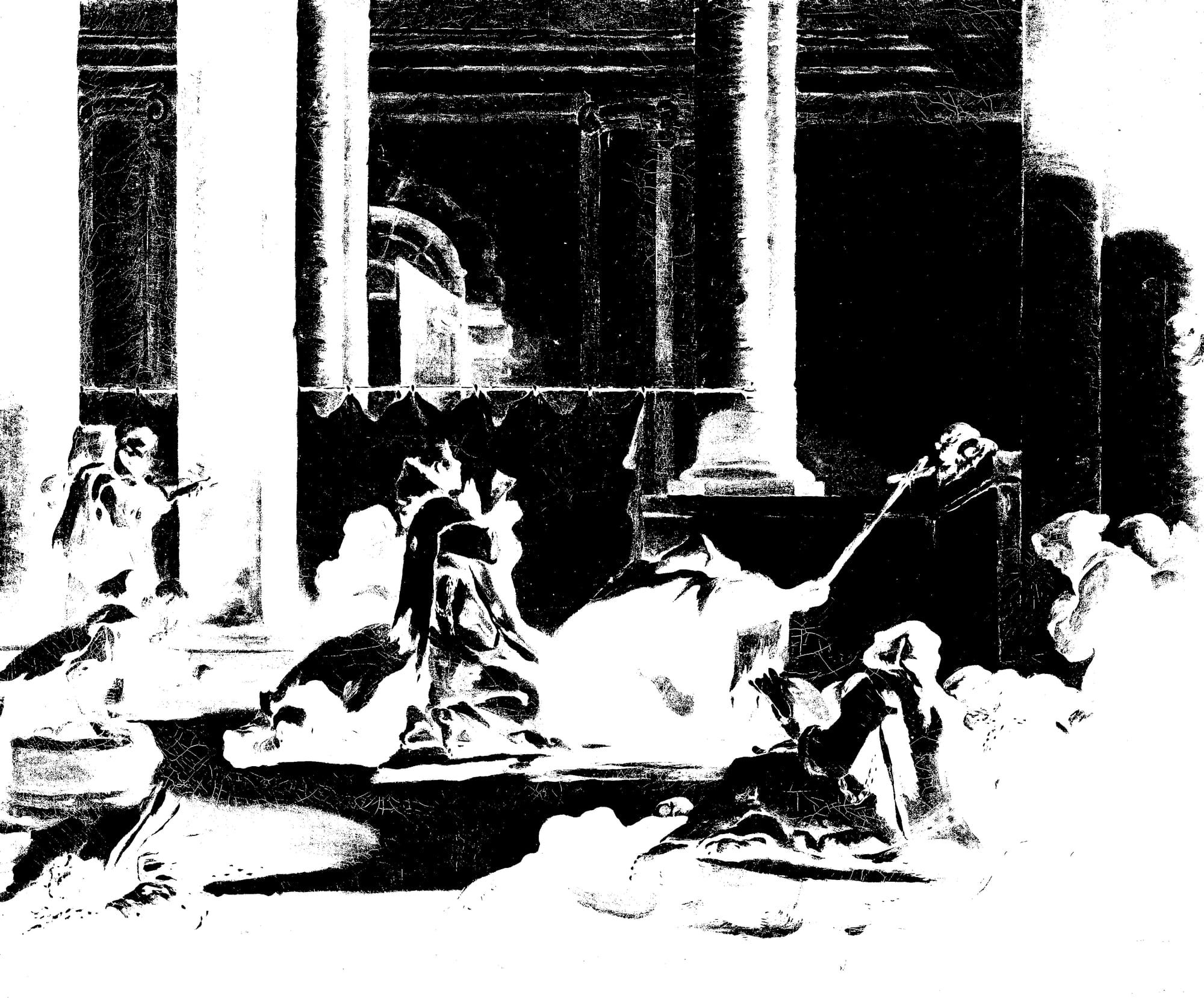
Three skulls piled on a low cold wall, all missing their lower jaws, as all the beggars are missing their true faith. Only one wretch is brave enough to reach forward with a scythe made of twine, rotten wood, and nicked iron. But the scythe falls short of the skulls, hangs in the air like those doomed to the gallows. I know what it means. Call me back.”
Now shivering, I stood up to grab my coat. But I took one look at the coat and remembered it was my husband’s, that I’d found it in my trunk weeks after I lost everything, that it had a black-red stain on the sleeve that the washer couldn’t get out. I rubbed the slick, sticky stain until Nadia coughed to get my attention.
Nadia screen-casted a painting onto her TV.
“My sister didn’t paint this,” Nadia said. “She couldn’t control her moods enough for art. It’s from the early eighteenth century, by a French guy with four names that jumble in my head. I found it in the National Gallery of Art after another terrible afternoon being content with despair. The Internet says it depicts Counter-Reformation rituals, but even then it makes no sense. There’s no halo to suggest saints’ skulls, no bright ray of light to guarantee divine providence.”
She pointed to the penitents’ bare feet with a glittering steak knife. I thought the knife was gonna come away bloody. She traced the chains wrapped around their torsos, their rags swaddling their scarred flesh, the heavy books weighing down their god fearing arms. She spoke again when her knife reached a teal curtain held up by an iron rod bolted into the marble columns.
“What struck me wasn’t the skulls,” she said. “You almost miss them like the drowning Icarus in that Bruegel landscape. And it also wasn’t that what my sister called a scythe was actually a cross made of twigs and twine.”
She traced the curtains to the far left of the painting to a hooded man carrying a heavy sack who was praying toward the open door behind the curtain.
“What believer having made it this far would look away from the moment of connection?” she said. “Why are the ragged beasts looking away from the door and toward the skulls? Why is this man bleeding from his head as he faces directly opposite the door?”
I had no answers for these questions. I had nothing to say. I was choked by the belief in
whatever madness fills broken people’s minds.
“My sister was not innocent,” Nadia said. “She cracked because nature cannot enact revenge. That was her self-proclaimed fate. But how her dream perfectly mirrored this painting she never saw consumed me.”
I nodded. I knew the feeling. It was all I had felt since Nadia had drowned me with her inspired words. I needed to be healed like her.
“Skulls, Nadia,” I said. “Where are the skulls?”
“Morgan, have you ever wondered if your husband started the fire?”
“Never. Colin loved me, our kids, our home. No, never.”
“What if I told you that the fire consumed his suicide note? That he wasn’t thinking right? That he was dying? Not of any physical illness, but a blotted mind. You knew that he’d get irrational, but you never peeked inside that locked diary in his nightstand. He couldn’t tell you that the walls told him he couldn’t let his kids grow up without him, that he tied their wrists and ankles with ropes soaked in lighter fluid, that he bit the wires, that he tasted the electricity in his right molar with cracked—”
I couldn’t hear the rest of what Nadia said because the icicle sharp images gouged my inner eye. The investigation had been too quick. My devastation was enough of an alibi. The cops or fire marshal or whoever held the narrative’s reins saw a murderer’s fingerprint and wiped it away with a fucking lie. I was infected with Nadia’s liberating truth. I could feel my face glow like Nadia had pressed hot wax on my lips. I turned, searching for my new reflection.
But I was suddenly paralyzed like the silent electricity had been sucked from my body.
My spine throbbed. I couldn’t force a breath. I was a head on a pike.
“Now, Morgan,” Nadia said, holding a blood tipped needle. “Do you wish to remain lonely? Or do you wish to bow before the truth?”
She opened a door and threw me down the uneven stairs. My forehead slammed into the handrail, splintering it. I watched as my limbs dislocated, my clothing tore, blood pooled under my skin in purple blotches. As she dragged me down the remaining stairs, I wished she’d stuck a needle into my eyes. I smelt the tangy cloud that hung over the room, invisible but ferocious.
Her basement was a garden of scattered flesh. Numb-mouthed heads hung from the ceiling from wire hooks. Cast in a moldy corner were limbless torsos latched together with thick black rope. Bruised blue and green arms, their fingers cracked in wild directions, surrounded a gnarled tree stump with more rings than history could fathom. The only thing that stilled the ripples of the stump were two skulls.
“Egos die,” Nadia said. “Eyes still. Brains dissolve. But bone, that hard animal matter never exhales a final breath, never utters last words. Bones only speak to those who can understand their whispers.”
She placed a pocket mirror at my eye level. I peered around the room for mercy. All I heard was the wet thunk of Nadia using the stump to whet a scythe.
Dan Dellechiaie is a fiction writer from New Jersey. His writing has appeared in Dodo Eraser, Partially Shy Magazine, The Scare You To Sleep Podcast, and elsewhere. He's also a staff writer for the anti-fascist punk magazine, knifetwister records new york. You can find more of his work at dadell.com. Instagram: @dan_dellechiaie
Your link has expired. Please request a new one.
Your link has expired. Please request a new one.
Your link has expired. Please request a new one.
Great! You've successfully signed up.
Great! You've successfully signed up.
Welcome back! You've successfully signed in.
Success! You now have access to additional content.