

The Lottery Man's Game

Written By: M. Atchleross Harliver Hill, defined by acreage east of the blue mountains, occupied land whose redeemable nature varied according to who was asked.
Written By: M. Atchleross
Harliver Hill, defined by acreage east of the blue mountains, occupied land whose redeemable nature varied according to who was asked. By the farmer and Virginia Department of Agriculture's measurement, their foothills were long claimed by the resolve and pervasiveness of the coyote. Any mother, daughter, cousin, and godfather knew full well what it meant to be bereft, each knowing someone who’d deserted the town with no indication of their whereabouts.
A common assessment amongst the generations was that, while their soil produced a lushness unlike any of their Piedmont counterparts, only bad luck was continually tilled.
The superstitious state of things is partially responsible for the town’s unwavering support of the Lottery Man, a sight that arrived once a year to replenish tickets at the crossroads gas station, but never on the same day. It was said the Lottery Man belonged to one of those societies recognized by the state. No one in Harliver Hill knew which. Not because he kept it as close to the chest as his name. No one ever asked. But people said lots of unsubstantiated claims. Lorraine Lowe knew not what to believe of the tales she’d overheard at her father’s butchery. Any kernel of truth was surely too forgone to fetch from the heap. Customers said as plainly as they would the weather that the Lottery Man once commanded all of the town’s crows to unload on Deputy Bibb’s house. Many tended to reembellish the theory of his great grandfather being none other than Mayor Moorson himself.
"That's how he know the Hill so well,” they’d say. This overwhelming sense of familiarity was the binding that stitched together all their tall tales. In her fourteen years, Lorraine had never been able to compare these secondhand observations against the real deal. This was to change on Plank Road.
That long, windy path was as lonesome and lifeless as its name suggested, save for the old barn past the thicket. Lorraine made a routine of eyeing it each morning from her school bus seat when no one else dared stare, convinced something within it took root in her. She’d come to associate the structure more as a lighthouse (perhaps because her only reference for such a thing was her grandmother's photos of Bowlers Rock Lighthouse; it too stood red-roofed, dilapidated, and full to the brim with antiquity).
During one of these school commutes, Ann Wheatley sat next to Lorraine. Lorraine suspected she’d done it to talk to someone else their peers pitied. Her classmate was deserving of the consolation; her father, Randy, became another one of those residents lost to the trees.
“I seen you at your daddy’s shop,” Ann mumbled, fidgeting with her pigtail. “That why you don’t eat meat? Or was you always that way?”
“It don’t do nothin’ for me, is’all,” Lorraine shrugged. “Had rabbit once. Didn’t mind that.”
“My daddy took me huntin’ with my brothers for the first time last year ‘fore he left us. We took cover in that shack you like to look at when the storm came in.”
Lorraine perked up.
“All that rain, and it was bone dry in there.”
Lorraine smiled to herself as if a secret sat between them and only she knew its name. She’d always thought the barn beguiling, even more so when she overheard her father make mention of it to a customer in the hush Lorraine learned to translate as foul plotting. She lay awake in her corner bed for a week, consumed by the idea it drew connection to the Lottery Man’s arrival, for her father couldn’t help himself when it came to financial risk and, most importantly, reward.
It was a gamble she wagered first by crawling out from under her sheets at midnight, dodging the floorboard creaks, and releasing the stone she’d wedged in the window. The October air came, twisting and guiding her descent down the house’s brick, so as to suggest it too risked something in its answering of a call. What lay ahead was a twenty-minute walk in the dark — plenty of time to reconsider or, in Lorraine’s case, talk oneself into conviction.
Most would’ve brought shoes, but she preferred her bare feet touching the earth. This route was one she’d not tread before, yet there was no hesitation in her steps. One after the other, never stopping to consider she may be the next the trees whisked away.
When the woods cleared out into an open field, she saw the rolling hills that flanked her barn.
Light shone out from its windows and wounds, and there was a shuffling of white around its perimeter, soft and fluttering like cake piping her mother often made for lemon layer cake.
White, which, upon a squinted eye, became bedsheets. Lorraine crouched on all fours as she slowly slit through the tall grass.
The blobs became outlines of people. Arms extended on either side and hunting boots visible from their pacing, hemlines muddy and frayed. A few rounded the corner from the backside of the barn, clutching hollowed-out pig heads. The contents of Lorraine’s stomach threatened to come up when they placed them over their own heads, giving them the silhouette of a scarecrow and pig that wished to swap lives and instead became circus contortion.
The wind was responsible for blasting the two large doors open, for nothing was on the other side to greet the men. And yet, they waltzed in with bravado, eager and ready to devour, completely filling in the space until none was left but the hay bales at the back. The doors shut as quickly as they’d opened, forcing Lorraine to hastily scamper over to the lowest opening on the left, where a portion of the wood had been taken by termites.
She could see only to the knees; some remained locked, and others couldn’t help their trembling.
Anticipation threatened to sink them all into the soil. Never had Lorraine envied the view of the crow more than she did upon seeing them fly over the roof and perch on an opening with an unobstructed view.
Heavy, clanking steps commanded everyone's attention. Lorraine knew it was him.
“Why is it you hide your face from me?” There was a suck of breath from some in response. He began walking through the crowd, the men parting with hopes and regard high.
His gait came to a halt. “Tell me, do you see fortune in your future from under there, Mr. Bibbs?”
Murmurs circulated amongst the group. A pig's head fell to the floor with its snout facing Lorraine, who covered her mouth so as to not give herself away.
Mr. Bibbs must’ve nodded, because the Lottery Man shifted to inspect another. “And what of you, Mr. Lowe? Have you found fulfillment in the slaughter?”
To Lorraine’s surprise, her hands didn’t shake.
“They come to me dead,” was all she heard her father say through slurred tongue. He’d had his way with the whiskey he thought was hidden behind the kitchen pie chest. This answer was half truth; Lorraine knew he exercised his anger at the slaughterhouse on occasion when her mother was away.
The Lottery Man released an unsatisfied hum, followed by the ceremonious taping of his right foot. “The locust tree would disagree.”
This retort produced a collective, defensive grunt, loud enough to stir the crows who still loomed above. A few men were compelled to shout and spit, decorum lost, which likely never existed in the room at all.
“Now now. Behave yourselves." His feet did this miraculous pivot to face the front. Lorraine could’ve sworn he’d leaped.
“We want the game!” shouted one, then echoed several, until all voices conjoined into one unsatiated bellow.
“The game?” mocked the Lottery Man.
More shouting. The man who did manage to pierce through his peers spoke of Randy Wheatley, saying he won the money to skip town from the Lottery Man’s game. Lorraine — and no doubt Ann — heard this tale from classroom circulation.
“What leads you to believe he skipped town?”
If it had been silent before the Lottery Man entered the room, this must be the nothingness the moon hears. Trepidation swallowed everyone whole.
The Lottery Man’s voice deepened, producing a foreign, scratchy baritone. “I find it unconscionable now, but there was a time I thought you and I were sent here with the same fervor for living. You used to sketch me in the sand and scatter me amongst the stars.”
He paced to the side closest Lorraine.
“Then, I watched you begin killing only for killing's sake. Your own kind. You see, I had to understand why.”
He sent a pebble flying across the room. “Have you no memory of shooting Randy from your fields last November?”
“Shoot him?!” yelled the cloaked man. “Randy’n I grew up together!” Other protests were hurled at the Lottery Man, but his pace never faltered. Lorraine watched as more than one of the men reached under their pants, and shortly after heard metallic clicking of a readied gun.
"Good luck" were the Lottery Man’s final words before a flurry of movement and rustling of ground rubble blurred Lorraine’s vision. Bedsheets were suspended in the air, creating a canopy until all that was left were their boots, trousers, shirts, belts, and guns on the floor. Before Lorraine saw their bodies, she knew what had been made of them. Frantic scratching at the door was followed by guttural, hopeless howls.
The doors flung open under their weight, and out came a grand spilling of coyotes who fled up the hill and into the woods with their newfound fright. All but the largest, who chose to sit a stone’s throw away from the barn and spectate. Without words, it answered to the half-cast light in the sky and then to Lorraine, who rose from the dirt with realization of her own.
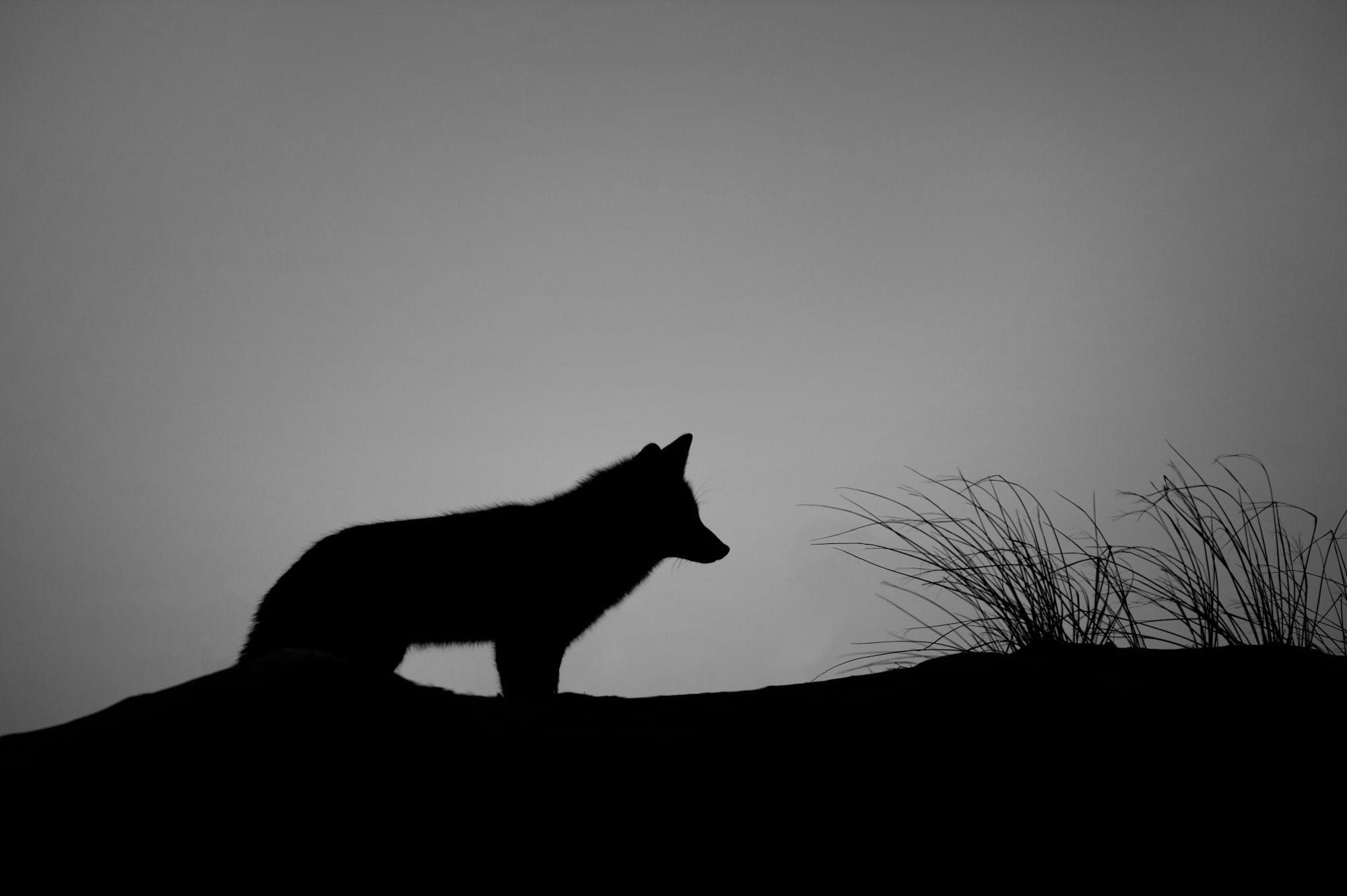
Her steady hands gathered the men’s belongings into a heap, adding hay in similar formation as she’d arranged before, and set it ablaze using a lighter taken from the sea of denim pockets. All this was done with haste. Not for lack of enjoyment, but it was the last task before the large coyote’s silhouette display as it ventured up the hill and beyond her sightline: coyote, human, coyote, human, coyote, human, then, always last, coyote. It had not been an act of luck that picked Lorraine and asked if she would be next — she knew this in the same way she knew the barn would stand unscorched come morning and her father would never be seen again.
M. Atchleross is a Richmond, Virginia-based writer, photographer, and appreciator of mid-century modern homes. Of her writing, one could say she’s taken after her land surveyor father, as her work often seeks to translate Virginia vignettes. While he uses his logbook for scribbling angles from control points to the corners of county houses, she uses hers for documenting the surviving shadows cast by our architecture, primarily those long demolished.
https://dogwooddriveva.substack.com/ https://www.instagram.com/dogwooddriveva
Your link has expired. Please request a new one.
Your link has expired. Please request a new one.
Your link has expired. Please request a new one.
Great! You've successfully signed up.
Great! You've successfully signed up.
Welcome back! You've successfully signed in.
Success! You now have access to additional content.